Small-Group Journeys with Marc Michael Epstein Peacock & Dragon Journeys — Curated Travel for the Intellectually Curious. A peacock and a dragon flank an illuminated wordmark amid foliate ornament with pomegranates and roses.

Eight to fourteen travelers. Itineraries I've built personally, from places I know well and people I've worked with on the ground for years. I've taught Jewish art and culture at Vassar for nearly four decades and I direct Beit Venezia, the home for Jewish culture in Venice. Jewish heritage runs through every trip; but Jewish life was always lived in and among the surrounding civilizations, so our trips reach further afield, into the worlds it shared the streets with: Christian Europe, Muslim Andalusia, the Ottoman East. Most of what we see takes special arrangement. Most of the people we meet are personal friends and longtime colleagues. As for the other travelers: people do not end up on a trip like this by accident. I want to enjoy the company I keep, and I want the travelers to enjoy one another. The result is a group that is curious, lively, generous, and unusually good company.

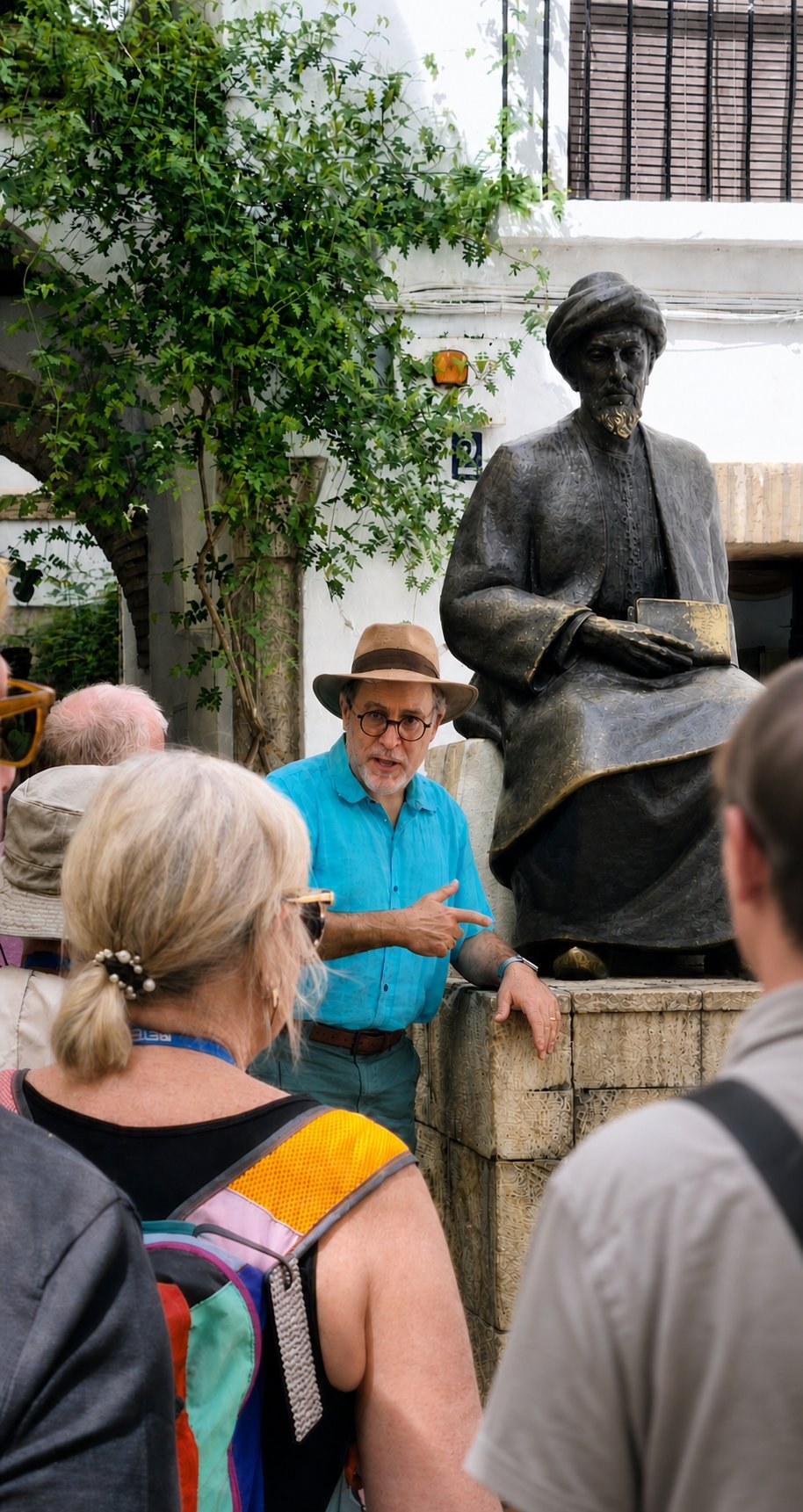
Marc Epstein in a turquoise shirt and Panama hat speaking to tour guests beside the bronze statue of Maimonides in the Plaza de Tiberíades, Córdoba.

Spain: Where Three Worlds Met

Spain is among the most fascinating places I know. For nearly eight hundred years, Christians, Muslims, and Jews lived in the same towns, often on the same streets. The Mezquita of Córdoba was a mosque before the Reconquista turned it into a cathedral, and stood across town from one of the great Jewish centers of the medieval world. In Toledo, we will read Castilian-style poetry written in Hebrew letters. In Córdoba and Granada, the Hebrew poets we will encounter were at once Jews, Arabs, and Andalusians: writing Hebrew with the music of Arabic in their ears, praising wine, gardens, patrons, exile, friendship, desire, God, and the pain of having more than one home.

The synagogue of Santa María la Blanca was built under a Christian king by Mudéjar craftsmen, with Hebrew dedications still on its walls. After 1492, what remained of all this did not exactly disappear. It scattered into the white villages of the Alpujarras, where Moriscos and conversos took refuge, and into the kitchens of southern Spain, which still contain a great deal of evidence if you know how to look.

The route runs from Toledo and Córdoba through Granada to Girona and Barcelona. The major sites get attention, but I tend to spend more time off the obvious route: Lucena, the medieval Jewish capital that operated for two centuries as a more or less autonomous town; the surviving mikveh of Besalú, still under archaeological study; slow afternoons in the winding streets of the Albaicín; conversations with curators at the Sephardi Museum in Toledo and with Spanish colleagues working on the slow reconstitution of Jewish life since 1992.

Our meals are memorable: mostly the regional vegetable cooking that long predates modern Spanish cuisine, and what the rest of Spain has been quietly filching from Andalusia for centuries. Kosher arrangements available throughout.
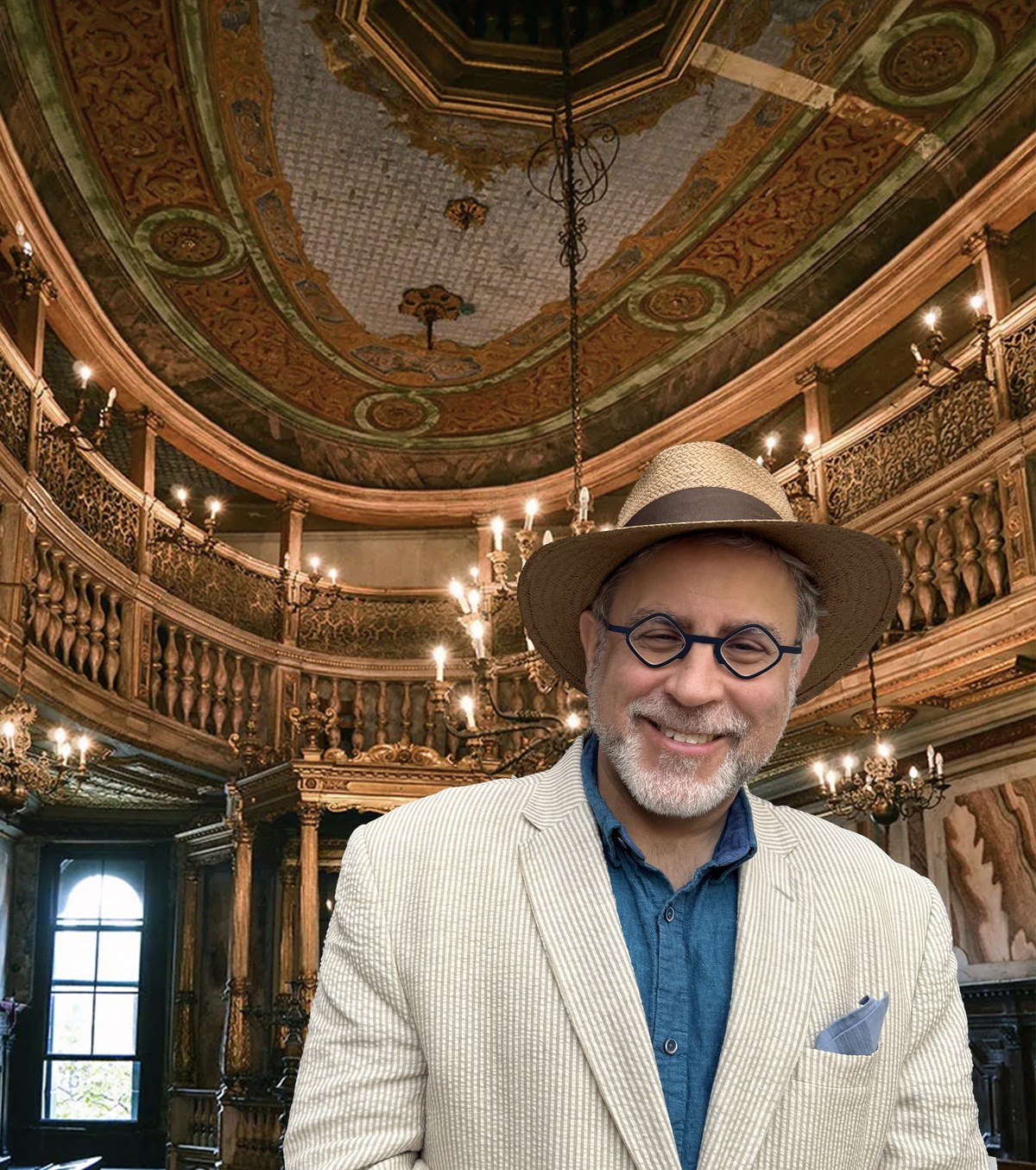
Marc Epstein inside a Venetian scuola.

Italy: The House of Memory

Jews, it is said, are more Italian than the Italians. They were in Rome before the Temple was destroyed in 70 CE. Italian Jewish life is the longest continuous Jewish presence in Europe, older than the European diaspora it preceded. The first ghetto was Venetian. The first printed Hebrew Bibles were Italian. The Roman synagogues preserve a rite of their own, neither Sephardi nor Ashkenazi. And no other country has imagined Jews more vividly than Italy: in painting after painting, fresco cycle after fresco cycle, in nearly every cathedral. Italian Jewish art, when it appears, is often a quiet answer to those imaginings.

Our route runs through Rome, Venice, Florence, and Padua. The Vatican Museums and the Sistine Chapel one morning; the Roman synagogues that afternoon, and the rite that has been heard in them for two thousand years. The Renaissance art of Florence set beside the Italian-rite siddurim that grew up in the same world. The Doge's Palace and the Scuola Grande di San Rocco; then, ten minutes away, the five synagogues of the Venetian Ghetto.

There are also places most travelers never reach: Pitigliano in southern Tuscany, called Little Jerusalem; matzah ovens and mikvehs; synagogues no longer in regular use, opened for us by their caretakers.

I direct Beit Venezia, the home for Jewish culture in Venice, which gives us an unusual base in the city: quiet rooms above the Ghetto, a working library, and the leadership of the Italian Jewish community across the table at dinner. There will be brick-oven pizza with live music at an estate in the Tuscan hills; cultural historians and curators in Rome and Venice; artisans reviving ancient crafts, including the creation of the silk taled, the Italian Jewish prayer shawl. In Padua, a period-instruments ensemble will play Jewish music from the period of the synagogue's establishment in the heartrendingly gorgeous jewel-box of a Baroque synagogue.

And there is the food: Roman carciofi alla giudia, Venetian sarde in saor, salt cod and chickpeas, the dishes that have always marked the meeting point between peasant and Jewish kitchens; kosher when needed.

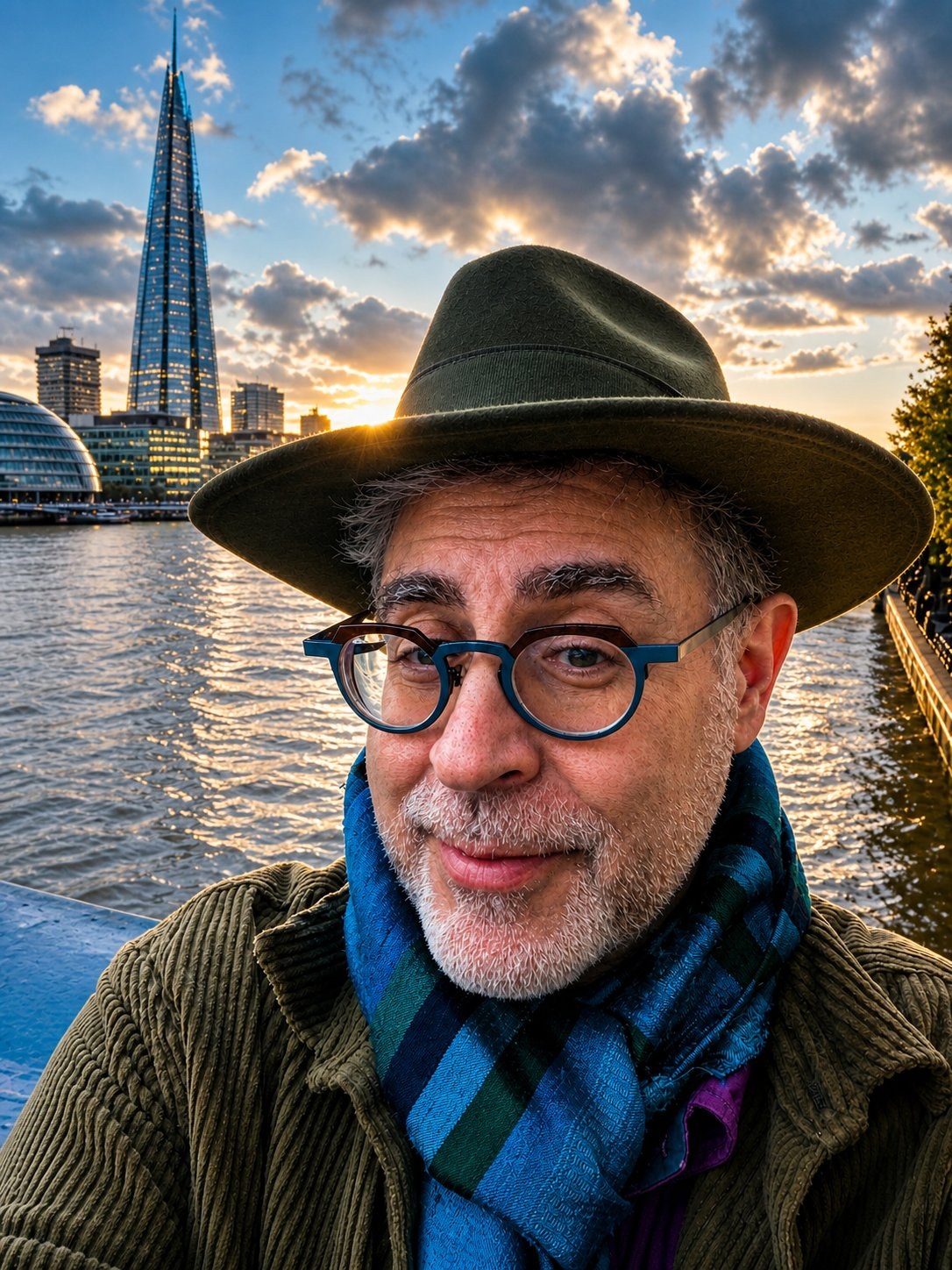
Marc Epstein in green felt fedora and tartan scarf along the Thames at sunset, with the Shard and City Hall visible behind him.

London: From Roman Walls to Global City

London is the city to which Jews have returned more times than any other in Europe. Settled here under William II, expelled in 1290, readmitted by Cromwell in 1656, joined by Sephardim from Amsterdam and Iberia in the eighteenth century, by Ashkenazim from Eastern Europe in the nineteenth, then refugees from Berlin in the 1930s, from Iraq and Iran later, from the Soviet Union in the 1980s. Each wave left buildings and books that are still in use. This is what gives Jewish London the layered character the trip is built around.

We'll explore Bevis Marks, the oldest continuously used synagogue in the United Kingdom, founded in 1701 by my own community, the Western Sephardim, and Lauderdale Road, where the choir preserves and treasures the Anglo-Sephardi musical tradition. Beyond those: Sandys Row, the small early-eighteenth-century Ashkenazi shul tucked into the East End. The Mile End Sephardic burial ground, the oldest Jewish cemetery in England. We will view the Hebrew treasures of the British Library with the keepers who know them intimately. Walks through Whitechapel, Spitalfields, and Stamford Hill that don't appear in most guidebooks. A Friday-night dinner with London family and friends, cooked by a celebrated chef, food writer, and deeply knowledgeable London host.

The people we meet are personal friends, not tour-arranged contacts. They are not in the habit of giving group lectures, and they don't. We sit with them in their homes, in their neighborhoods, in the great places of which they have charge, and we talk. Because the only way to really get to know a city is through the eyes of those who live in it every day.

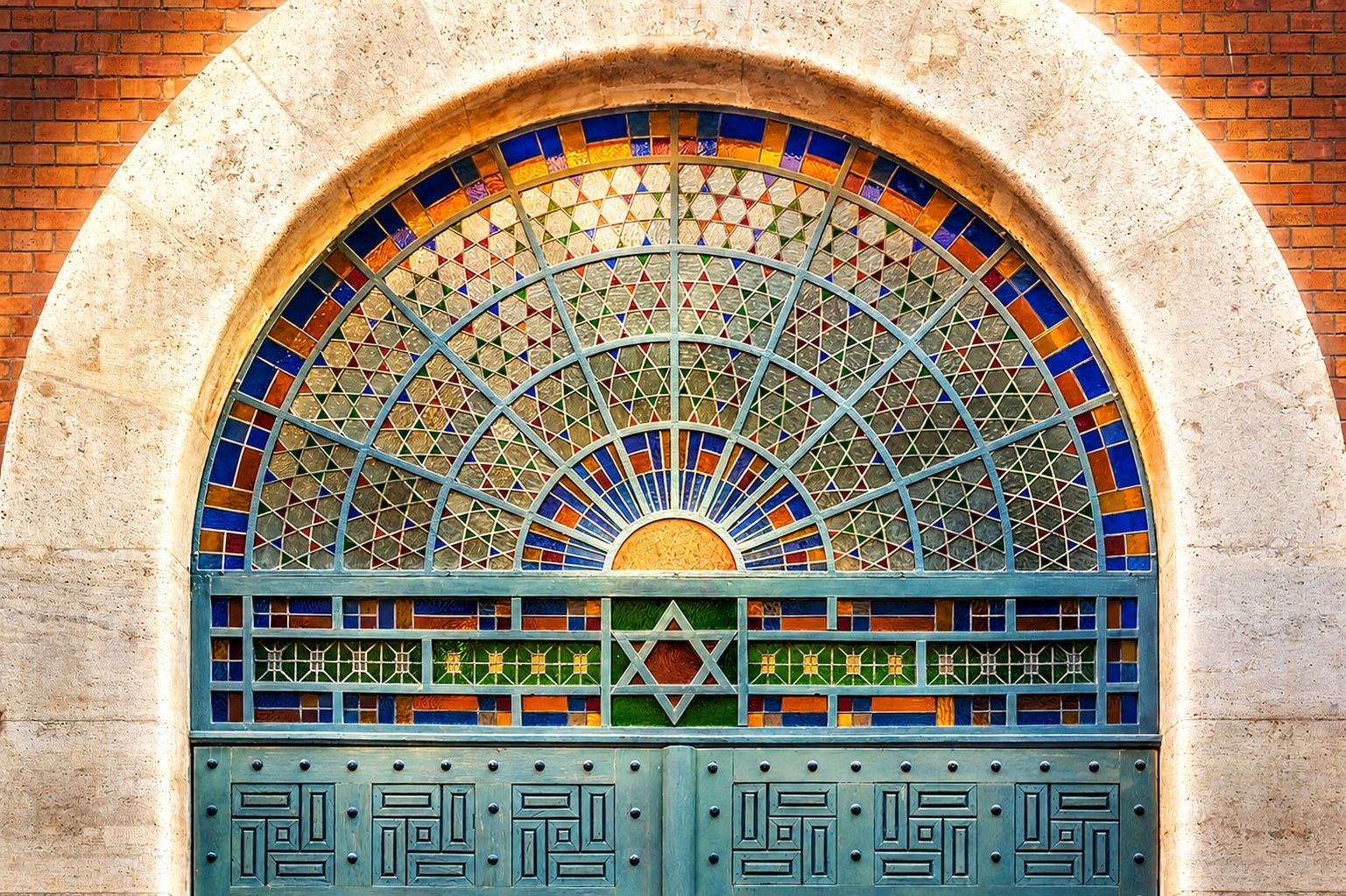
Stained glass arched window with Star of David above the painted blue doors of a Budapest synagogue, set into a brick façade.

Berlin, Prague & Budapest: Splendor, Ruin, Return

Three cities, twelve days. Prague's Altneuschul has been in continuous use since the thirteenth century. Budapest's Dohány Street Synagogue, built in the 1850s, was then the largest in Europe. Herzl was born a few steps away. Berlin gave the world Mendelssohn, Buber, Scholem, Arendt, and a dozen other makers of modern Jewish thought. Then, within a single decade, much of that world was destroyed.

Both halves of that history are made real and present on this trip: the dense, magnificent civilization that was built in these cities, and the devastation that nearly ended it. Prague alone offers an almost overwhelming archive in stone, manuscript, memory, and legend: the Altneuschul, the Old Jewish Cemetery, the Jewish Town Hall, the Maisel, Klausen, Spanish, and Pinkas synagogues, the Ceremonial Hall, the layered streets of Josefov, and the traces of a community that was at once local, imperial, rabbinic, mercantile, mystical, and modern.

The route moves among the three capitals. The famous sites are visited with loving attention and discussed from perspectives you won't get elsewhere: Prague's old Jewish quarter and its remarkable synagogues; Dohány Street and Rumbach Street in Budapest; the Neue Synagoge and the Jewish Museum Berlin. The smaller things matter as much: the courtyard shuls hidden in Prague's Josefov; the Kazinczy Street Orthodox synagogue and the tiny surviving prayer rooms in Budapest's Seventh District; the renewed Jewish quarter in Berlin's Mitte; klezmer evenings where the music is alive rather than merely remembered.

We meet the people who make Jewish life in Central Europe alive today, perhaps more than at any time since the destruction: rabbis, archivists, curators, writers, musicians—people who can speak from within, and with some authority, about what Jewish life there actually looks like now. They are not many, and they tend to change the way one thinks about the place.

The food is remarkable, too: the old kosher patisseries of Budapest, with their flódni and kindli; the new Mediterranean restaurants across Prague and Berlin; the cafés, markets, bakeries, and local tables where memory and appetite are not easily separated. And the museums, though less famous than the Louvre or the British Museum, hold an astonishing concentration of treasures. There is much to see, to do, to think about, and to talk over with fellow travelers who are both interesting and interested.

In the News

Vassar Goes to the Source Over Spring Break, on the 2025 Jewish Studies Travel Seminar in Spain led with Prof. Rabbanit Ági Vetö and 22 Vassar students. Vassar News, April 2025.