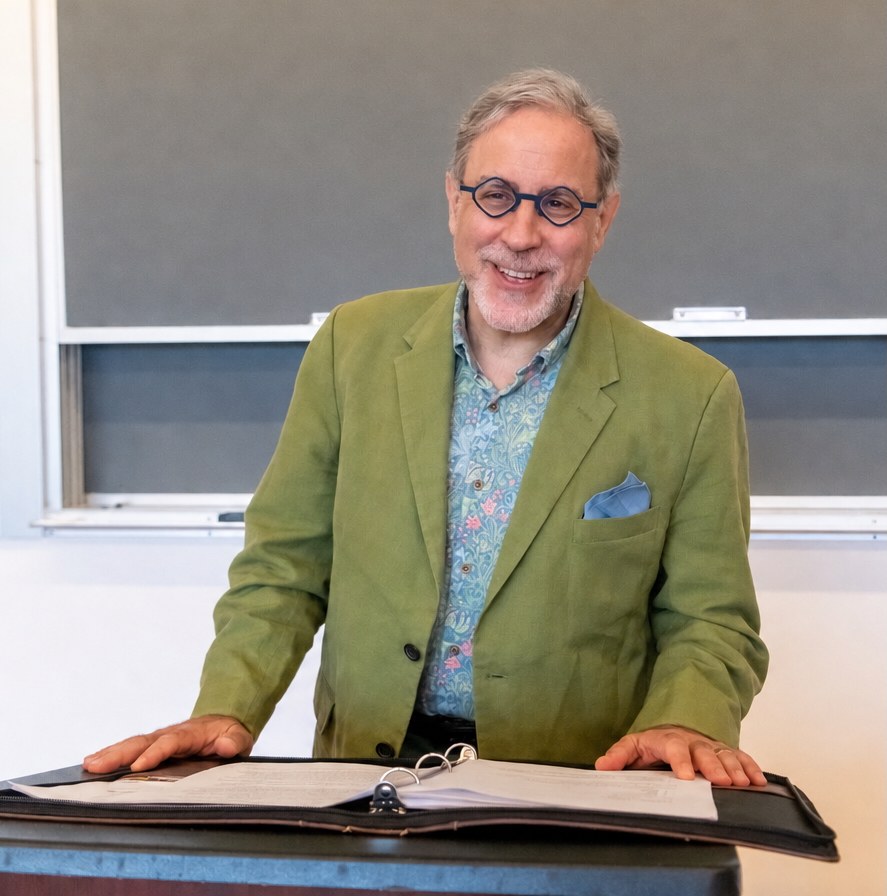
Biography
Marc Michael Epstein is Professor of Religion and Visual Culture on the Mackie M. Paschall (1899) & Norman Davis Chair and Director of Jewish Studies at Vassar College, and serves as Direttore of Beit Venezia, a center for Jewish culture in Venice. Trained as an art historian of religion, his work focuses on Jewish visual culture, medieval and early modern manuscripts, and the complex visual dialogues between Jews and Christians in Europe from antiquity through the modern period.
He is, most recently, the author of People of the Image: Jews & Art (Penn State University Press, 2025), a synthetic reinterpretation of Jewish engagement with the visual arts across three millennia. His earlier monograph, The Medieval Haggadah: Art, Narrative, and Religious Imagination (Yale University Press, 2011), was listed among the Times Literary Supplement’s Best Books of the Year and received the Jordan Schnitzer Prize from the Association for Jewish Studies. His edited volume Skies of Parchment, Seas of Ink: Jewish Manuscript Illumination (Princeton University Press, 2015) won the PROSE Award in Art History & Criticism and the National Jewish Book Award (Arts), and is widely regarded as a foundational work in the field, as is his first book, Dreams of Subversion in Medieval Jewish Art and Literature (Penn State University Press, 1997). His forthcoming book, Jewish Spaces in Christian Art: 1300–1600, examines how Christian artists imagined Jewish sacred and domestic spaces, revealing the theological and political work performed by visual representations of Jewish presence.
Epstein has also co-authored and edited major facsimile and art editions of illuminated Hebrew manuscripts, including The Jerusalem Haggadah (Aryeh Editions, 1999), The Brother Haggadah (Thames & Hudson, 2016), La Bibbia miniata della Comunità ebraica di Venezia (Il Prato, 2017), and The Lombard Haggadah (Paul Holberton, 2019). He has translated and annotated classical liturgical texts in his New Venice Haggadah and New Venice Esther (Edizione Damocle, 2021 and 2025). These projects combine close art-historical analysis with attention to ritual practice, patronage, and cultural exchange. His scholarly articles have appeared in venues such as The Art Bulletin, Prooftexts, The Cambridge History of Judaism, and The Jewish Annotated New Testament.
A frequent keynote and distinguished lecturer, Epstein has spoken at institutions including the Library of Congress, the Getty Research Institute, the Metropolitan Museum of Art in New York, the Israel Museum in Jerusalem, the Museum of Fine Arts in Boston, Stanford University, Duke University, UCLA, the Pontifical Gregorian University in Rome (during which time he was invited to present his books to both Pope Francis and Pope Leo XIV), and the British Library. He has held visiting lectureships and residencies across Europe, Israel, and North America, and is widely known for his ability to bring manuscript studies and visual analysis into dialogue with theology, literature, and social history.
At Vassar, Epstein teaches courses ranging from an introduction to what he calls JudaismS, to an exploration of the radical biography of Jesus, to advanced seminars on Jewish art, medieval manuscripts, and visual theology. He is deeply committed to experiential learning, having developed intensive, hands-on manuscript and material culture projects with undergraduates, as well as international travel seminars in Italy and beyond. His curatorial and transmedial projects integrate scholarship, performance, music, and digital humanities, often in collaboration with students. He is also the principal organizer of Kehillah Kedosha Zikhron Zvi, a traditional egalitarian prayer community in the Western Sephardic liturgical tradition, and has worked closely with cantors and choirs to arrange and adopt Western Sephardic liturgical music for Bevis Marks and Lauderdale Road synagogues in London, and for Shearith Israel in New York City.
During the 1980s, Epstein was Director of the Hebrew Books and Manuscripts division of Sotheby’s Judaica department, and continues to serve as consultant to libraries, auction houses, museums, and private collectors throughout the world, among them the Herbert C. and Eileen Bernard Museum at Temple Emanu-El in New York City, for which he curated the inaugural exhibition, and the Fowler Museum at UCLA.
Epstein’s work has been supported by the Mellon Foundation, the Lucius N. Littauer Foundation, the David Berg Foundation, and the Fishman Family Endowment for Jewish Studies, among others. In 2024, the Orange County Community Scholar Program — where he had earlier served as One-Month Scholar in Residence — honored him with its highest distinction, the CSP Maimonides Award for Excellence in Jewish Learning, recognizing decades of adult Jewish education. His scholarship is characterized by methodological rigor, interpretive boldness, and sustained attention to how images function as sites of memory, polemic, devotion, and cultural negotiation within Jewish life. Epstein regularly leads both students and adult continuing learners on Jewish Heritage tours of Spain, Italy, and Central Europe.
Download CV (PDF) →Featured
- Why Multidisciplinary Studies Matter · Vassar Quarterly, Fall/Winter 2025
- Award-Winning Director of Jewish Studies Nurtures Students of All Backgrounds · Vassar News, 2024
- Vassar Goes to the Source Over Spring Break · Vassar News, April 2025
- CSP Maimonides Award for Excellence in Jewish Learning · Community Scholar Program, August 2024
- Way To Go, Vassar! — National Jewish Book Award · Vassar Quarterly, Winter 2016